Yaw Vertical axis
Rotation about the vertical axis — the plane of everyday turning. Stimulates the horizontal semicircular canals.
Introducing the Orbital
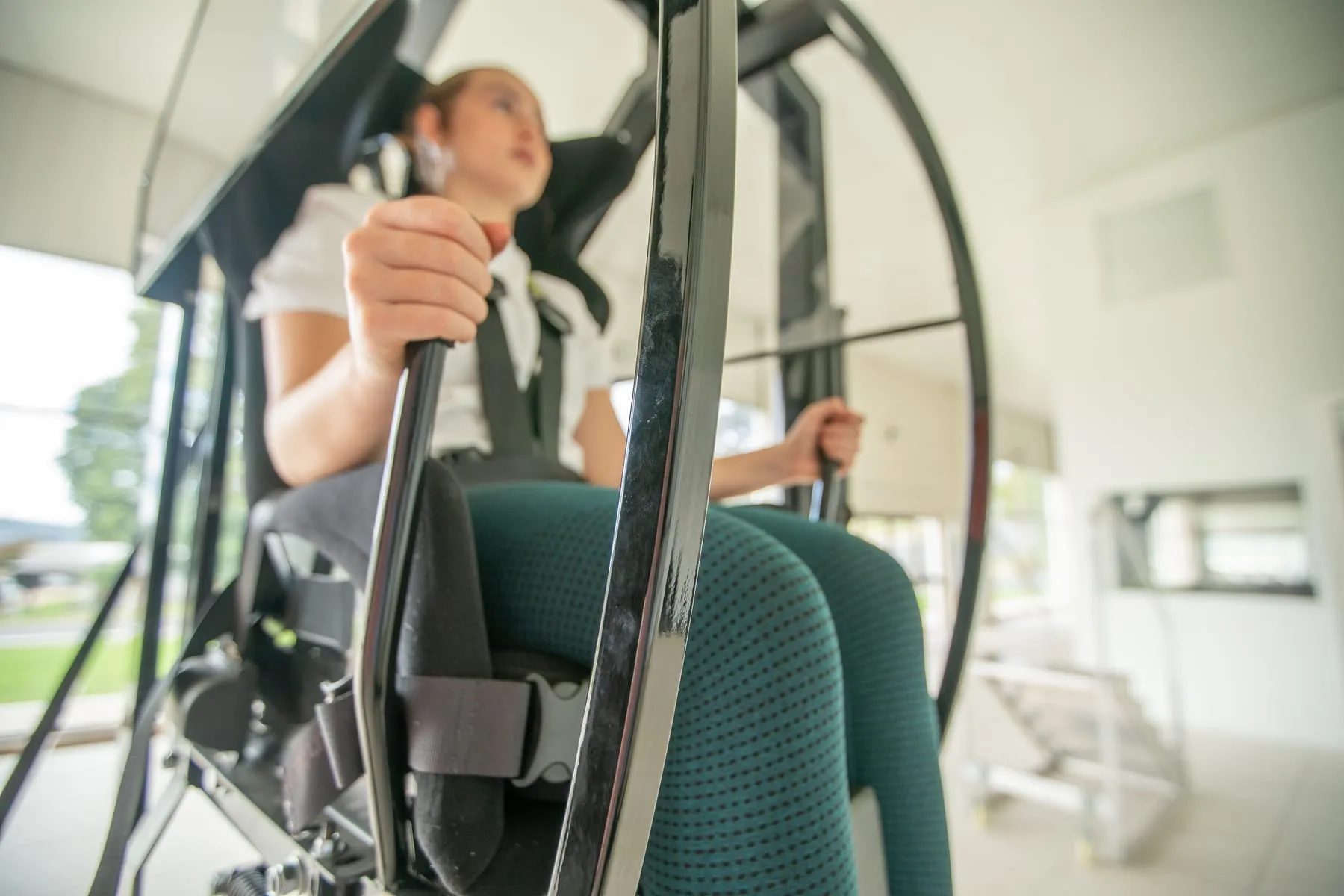
The Orbital rotates the whole body through three axes — yaw, pitch and roll — to deliver a controlled, novel vestibular stimulus designed to support sensory-motor integration.
For hospitals, neuroscience centres & clinics · A Brain Based Therapies device, made in Australia

The device & the science
The Orbital is a next-generation vestibular rehabilitation device. A patient is safely secured in the seat and rotated through independently controlled yaw, pitch and roll planes — targeting each semicircular canal and both otolith organs, individually or in combination.
Designed to be used alongside objective assessment, so clinicians can measure change rather than rely on report alone:
How it works
The vestibular system is one of the most widely connected networks in the brain — reaching balance, gaze, spatial orientation, autonomic regulation and cognition. By delivering controlled motion the body rarely encounters, particularly in the roll plane, the Orbital is designed to present the nervous system with a fresh sensory challenge.
Rotation about the vertical axis — the plane of everyday turning. Stimulates the horizontal semicircular canals.
A nodding motion about the side-to-side axis, engaging the vertical semicircular canals and the otolith organs.
A lateral, sagittal-plane rotation unlike any activity of daily living — the Orbital’s most novel and distinctive stimulus.
Novel stimulus“Full-body multi-axis rotation stimulates the vestibular, proprioceptive and visual systems to create neuroplastic changes — modulating the entire human neuraxis.”
Use cases
Because it stimulates a system connected across the whole neuraxis, multi-axis rotation is being applied — as an adjunct, within individualised programs — across a wide range of presentations.
Retraining gaze stability, balance and spatial orientation where the vestibular system has been disrupted.
Supporting sensory-motor recovery after mild traumatic brain injury, particularly where symptoms persist.
An adjunct within multimodal programs for functional neurological presentations.
Stimulating residual function where recovery has plateaued or capacity is declining.
Building postural stability and reducing falls risk where balance is failing.
Individualised, assessment-led programs at the frontier of sensory-motor training.
These are areas of clinical application and active investigation. The Orbital is intended for use by qualified healthcare professionals as an adjunct to clinical care; it is not presented as a stand-alone treatment or a guarantee of outcome in any condition.
The evidence
We separate two things clearly: the Orbital’s own early-stage published studies, and the broader, established evidence for the therapeutic approach it delivers. Read both, and judge for yourself.
Single case · Dizziness Handicap Inventory 32% → 20% over a four-week program.
Download PDF 1.4 MBChiropractic care combined with vestibular stimulation; three of four described complete symptom resolution.
Download PDF 3.3 MBObjective saccadometry and force-plate posturography; both patients returned to work.
Download PDF 9.2 MBTwo patients with functional seizures and movement disorder within a multimodal program.
Download PDF 0.9 MBThese references concern vestibular rehabilitation and vestibular stimulation as therapeutic approaches — the principles the Orbital applies — not the Orbital device itself.
Clinical practice guidelines give vestibular rehabilitation a strong-evidence recommendation to reduce dizziness and improve gaze stability and balance in vestibular hypofunction.
Hall et al., J. Neurologic Physical Therapy (APTA), 2022 ↗A Cochrane review of 39 randomised trials (2,441 participants) found moderate-to-strong evidence that vestibular rehabilitation is safe and effective, with no adverse effects reported.
McDonnell & Hillier, Cochrane Database of Systematic Reviews, 2015 ↗In a randomised controlled trial, cervico-vestibular rehabilitation shortened the time to medical clearance after sport-related concussion.
Schneider et al., British Journal of Sports Medicine, 2014 ↗A 2025 meta-analysis found vestibular rehabilitation produced a large reduction in dizziness handicap in persistent postural-perceptual dizziness versus controls.
Li et al., Frontiers in Neurology, 2025 ↗Meta-analytic evidence supports vestibular rehabilitation for clinically meaningful improvement in dizziness-related quality of life in vestibular migraine.
El Ahdab et al., Headache, 2025 ↗In a randomised trial of older adults at high falls risk, vestibular rehabilitation reduced the mean number of falls at 12 months (10.96 → 3.03).
Rossi-Izquierdo et al., Aging Clinical & Experimental Research, 2018 ↗A meta-analysis found vestibular stimulation, particularly caloric stimulation, can temporarily reduce signs of hemispatial neglect after stroke.
Wheeler, Smith, Sakel & Wilkinson, Neuropsychologia, 2024 ↗Early meta-analytic evidence indicates galvanic (including noisy) vestibular stimulation can favourably affect postural balance in Parkinson’s disease.
Mahmud et al., Journal of the Neurological Sciences, 2022 ↗Repeated rotational vestibular stimulation habituates the brain’s velocity-storage mechanism — direct evidence of experience-dependent central adaptation.
Yakushin et al., Frontiers in Neurology, 2017 ↗Practices & settings
From tertiary hospitals and neuroscience centres to private clinics and research institutes — a compact platform that adds a genuinely new capability.
A capital instrument for neuroscience, ENT and rehabilitation departments building advanced vestibular services.
Adds a novel, measurable stimulus to concussion, stroke and balance rehabilitation programs.
A differentiating capability for private practices managing dizziness and post-concussion caseloads.
Gaze-stability, balance and sensory-motor conditioning for athletes and tactical populations.
A controllable multi-axis platform for vestibular and sensory-motor integration research.
Balance and vestibular conditioning to reduce falls risk across ageing populations.
Why it fits
On-site training and comprehensive documentation, backed by global support.
Target each axis — or any combination — to engage all six semicircular canals and both otolith organs.
A considered design that removes needless complexity: maximum capability, minimum investment.
Compact footprint, standard mains power and low maintenance — it fits into busy departments.
Distribution
We are appointing authorised distributors across India and the broader subcontinent to place, install and support the Orbital in hospitals, neuroscience centres and clinics. Practitioners are connected with their regional distributor for pricing, installation and training.

The inventor
The Orbital was designed by Dr David Richardson, a chiropractor with a special interest in vestibular rehabilitation and sensory-motor integration. Across years of practice with patients whom conventional approaches had failed — persistent dizziness, post-concussion syndrome, functional neurological disorder — he built the Orbital to deliver a controlled multi-axis stimulus, and has documented its clinical use in a series of peer-reviewed case reports.
His premise is simple: much of chronic neurological dysfunction is a failure of sensory-motor integration — the nervous system working from poor information. The Orbital is one instrument in a measured program designed to restore it.
Practitioner library
Verified clinicians get access to device demonstrations, the full instruction manual, published evidence, testimonials and registration documents. Access is invite-only and granted under confidentiality.
Stay connected
Dr Richardson’s forthcoming book, Clinical Applications of Multi-Axis Rotation, covers functional vestibular anatomy and the clinical rationale for the therapy — subscribers receive the first two chapters ahead of release. His newsletter shares new evidence and Orbital news, occasionally and never as spam.
Register interest
Tell us about your hospital, centre or practice and we’ll be in touch with pricing, availability and clinical documentation. Enquiries from India and the subcontinent are handled by our authorised regional distributors.
Intended for use by qualified healthcare professionals as an adjunct to clinical care.